
Our Services
Glaucoma Treatment
From the beauty of daily life to the faces of our loved ones, our eyes enable us to connect with the world around us. However, not every eye condition provides an early warning. One such condition is glaucoma. Often referred to as the "silent thief of sight," it can progressively impair your vision without creating any discomfort or symptoms until it's too late.
Consult Now
About Glaucoma
One of the main causes of blindness in adults over 60 is glaucoma. Although it can happen at any age, older persons are more likely to experience it.
Most people do not realize they have a problem until significant damage has been done because vision loss usually happens gradually and painlessly. Usually, peripheral vision—that is, the area around your nose—is lost first. You may have “Tunnel Vision,” which is vision that has narrowed to only see what is directly in front of you, similar to gazing through a train tunnel, while bigger portions of your peripheral vision vanish.
Outsmarting Glaucoma
-
Individuals aged 40 years and above
-
People with diabetes or blood sugar-related eye issues
-
Those with a family history of glaucoma, especially siblings or children above 35 years of a diagnosed patient
-
High myopia patients (those wearing high minus power glasses)
-
Anyone experiencing eye discomfort or visual problems, such as:
-
Persistent headaches without any clear cause
-
Blurred vision not improved with corrective lenses
-
Recurrent redness or pain in the eyes
-
Seeing colored rings or halos around lights
-
-
Individuals who have been on long-term steroid use — tablets, creams, or inhalers
Diagnostic Tools Available at Our Centre
-
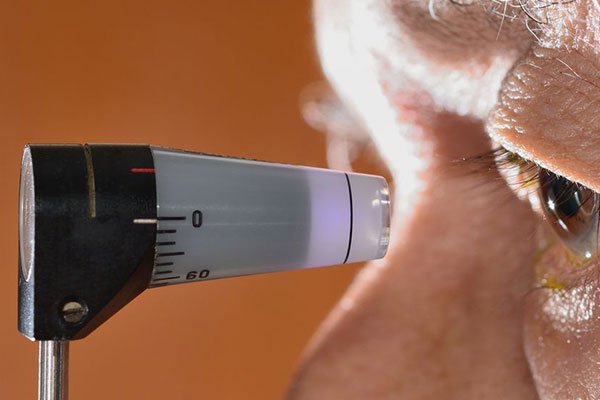
Measurement of intraocular pressure with an Applanation, Perkins, or non-contact tonometer
-
Gonioscopy to assess the eye’s angle
-
The best tool for visual field analysis is the Humphrey Field Analyzer (HFA).
-
OCT (Optical Coherence Tomography) of the Optic Nerve Head
Our Treatment Protocol
-
Following a glaucoma diagnosis, our experts will go over the available treatment options with the patient.
-
Eye drops are typically used as the initial treatment to lower intraocular pressure.
-
Regular follow-up appointments are necessary, often every three to six months.
-
The fact that treatment is ongoing is a crucial factor to remember.
-
At every follow-up appointment, the glaucoma specialist will modify the medication according on the clinical findings. The significance of lifetime treatment must be emphasized because most individuals have no symptoms at all.
- A Laser Peripheral Iridotomy (LPI) may be recommended for patients with angle closure glaucoma or narrow angles, which indicate that the gap between your iris (the colored portion) and cornea (the transparent outer layer) is too tiny.
-
In LPI, a tiny hole is made in the iris using a laser beam. Pressure can be released by draining the excess fluid.
-
Patients with advanced glaucoma who do not react to drops may be recommended to have a trabeculectomy. This process opens up a new channel for the drainage of fluid from the eye. It is carried out in the operating room as an outpatient treatment.
Normal vs Glaucoma Vision
Understanding the Types of Glaucoma
It helps to know that there are different types of glaucoma, each with its own cause and treatment approach:
- The most prevalent type, primary open-angle glaucoma (POAG), causes a gradual, painless loss of vision.
- Less frequent but more dangerous is angle-closure glaucoma. It may be uncomfortable and appear suddenly.
- Normal-Tension Glaucoma: Optic nerve damage happens even when eye pressure is normal.
- Congenital glaucoma: Usually detected early in infancy or childhood.
- Secondary glaucoma is brought on by another illness, such as steroid use, inflammation, or trauma.
Can Glaucoma Be Prevented?
While glaucoma cannot always be prevented, early detection can stop or slow vision loss. You can reduce your risk by:
- Setting up routine, thorough eye exams
- Controlling medical disorders including high blood pressure and diabetes
- Regularly using the recommended eye drops
- Putting on safety glasses to prevent harm
- Steer clear of self-medication, particularly with steroids
What to Expect During a Glaucoma Test
During your glaucoma check-up, your ophthalmologist may perform the following:
- To evaluate peripheral vision, use the Visual Field Test.
- Coherence of Optics Optic nerve head analysis using tomography
- Pachymetry: a method for determining corneal thickness
- YAG To assess the drainage angle, use laser peripheral iridotomy and gonioscopy.